Impact
Results
🏆 Scaled from 3,000 MVP users to 20,000+ monthly active users across 5 RBC corporate offices within 6 months.
🏆 Achieved 34% adoption across eligible employees within 8 weeks of launch, validating the need for experience.
🏆 70% of surveyed employees reported a significant improved in-person planning attributed to our product.
Why this work mattered
The Problem

There were no official consequences for non-compliance. Without any official consequences, Attendance was socially driven. Employees lacked visibility into:
The Opportunity
If employees could easily see when relevant colleagues would be in-office and secure their desk in advance, they would plan attendance more intentionally.
This could improve:
💪 In-person collaboration
💪 Desk utilization
💪 Adoption of return-to-office policies
Constraints
The solution needs to balance organizational realities with user autonomy.
Desk capacity was lower than employee count
Attendance policy could not be enforced through penalties
Privacy concerns around workplace tracking
Integration with legacy booking infrastructure
Multi-office scaling requirement
The Solution
I designed a 0->1 mobile app that acts as a workplace coordination system for employees.
Share and view in-office schedules
Automatically reserve desks
Secure workspace through real-time check-ins
Coordinate attendance with relevant teammates
In-Office Scheduler
Employees can indicate upcoming office days and see when relevant colleagues will be on-site.
To improve schedule reliability:
Schedules automatically synced with desk bookings, badge taps, and room reservations
Employees retained full control and could opt out of syncing
Default visibility focused on direct team + skip-level collaborators
This reduced coordination friction and helped employees see the value of attending the office.
Automated Desk Booking
Desk reservations were tied to planned in-office days, reducing booking friction.
System auto-assigned desks on user’s home floor
Recurring desk assignments increased predictability
Reduced manual booking steps significantly
Employees spent under 30 seconds securing workspace.
Morning Check-In & Desk Release
Desks were automatically released if users did not check in by 10:30 AM
Availability updated in real time
Policy aligned with HR operational constraints
This improved desk utilization and reduced workspace conflicts.
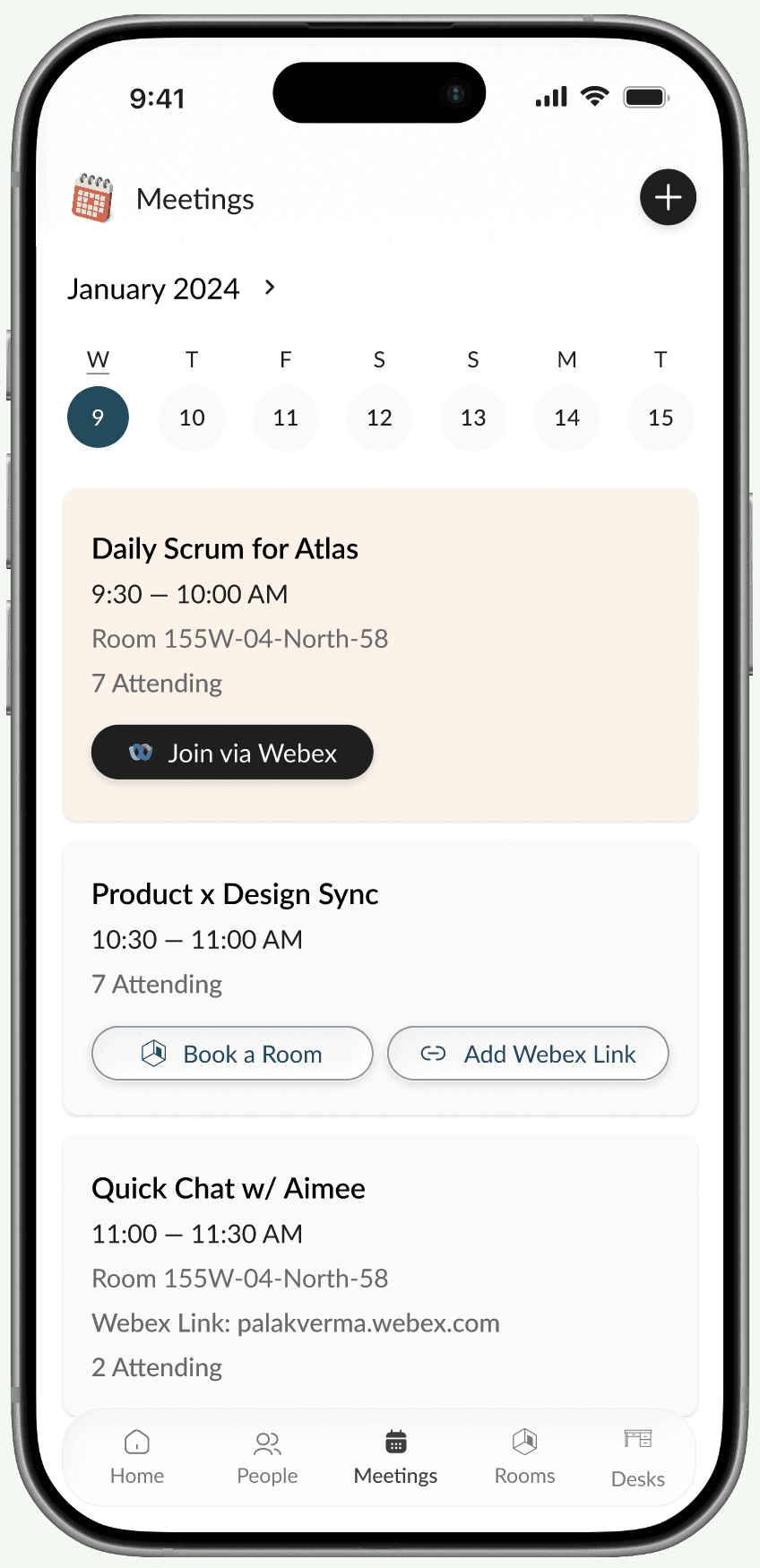
Room Booking
Desks were automatically released if users did not check in by 10:30 AM
Availability updated in real time
Policy aligned with HR operational constraints
This improved desk utilization and reduced workspace conflicts.
Leadership & org contribution
Defined experience strategy for attendance coordination
Influenced HR policy decisions (desk release timing)
Facilitated cross-team design reviews
Worked closely with Workplace Ops to validate real-world constraints
What would i do next?
Predictive attendance recommendations
Unified desk + room + meeting coordination flow
Collaboration density insights for managers
Workspace demand forecasting